
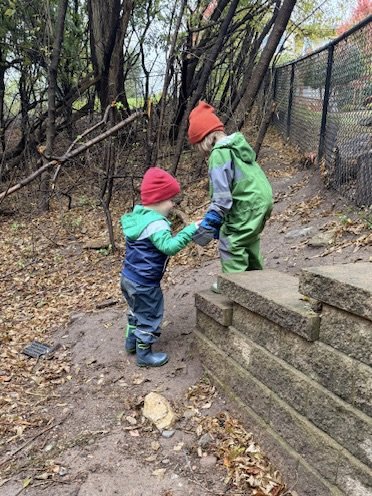
I’ve been thinking a lot about kindness lately. With so many frightening and unsettling events happening in the world, and especially here in our own state, I often find myself overwhelmed with emotion. Some days it’s hard to hold onto positivity and hope. I feel like I’m swinging from one emotion to the next: anger, sadness, worry, disappointment.
And yet, at the very same time, I feel something else too: immense pride in the strong, compassionate, and supportive people in our community. Yes, terrible things are happening in our state and across our country, but there is also so much good, so much generosity, so much kindness. It is something we need more of right now.
In my family kindness isn’t optional or situational. It is a requirement. It’s something my husband and I are intentional about modeling as we raise our own children. We try to teach it through our words and our actions by coaching our kids through social situations, encouraging empathy, tolerance, and reminding them to listen before judging. We encourage them to pause and consider what circumstances may have shaped someone’s thoughts or actions before forming an opinion, to give grace, to lead with love, and to choose kindness, even in the face of adversity.
It is constant work, but it is important work and while we are far from perfect I’m seeing these lessons take root as our children grow. During my fifth grader’s school conference, we heard about his academic progress, his cognitive abilities, his listening skills, and his ability to follow directions: all valuable data. His teacher also shared this: “He always shows kindness to his classmates when they are having a hard moment.”
That was the biggest takeaway for me, the most valuable insight, and it gave me the greatest sense of pride. He is kind to others. In a world that can feel heavy and uncertain, that piece of information about his performance in a classroom feels like everything.
One of the most common questions from families we hear as preschool teachers isn’t about academics, but rather, “Are they kind?” and “Are they making friends?” For me, that remains the priority. I want for the children I teach what I want for my own children: that as they navigate school and the complex academic and social challenges that come along with it, they are rooted in kindness.
Encouraging empathy and kindness in our classroom is a daily practice from the beginning. At the start of each year, we create our guiding principles together, beginning with: Everyone is welcome. Everyone can play. Our classroom is a community, and we help our community.
Those principles are evident in many ways as we move through the day. We talk openly and without judgment about feelings. We help children see both sides of a disagreement. We encourage them to check in on a friend who is sad, mad, or hurt, whether they were involved in the situation or not. We model kindness, role-play conflict resolution, and practice using kind words and kind tones of voice. Through books, small-group conversations, and whole-class discussions, we reinforce these lessons every day. And when we see kindness, we celebrate it.
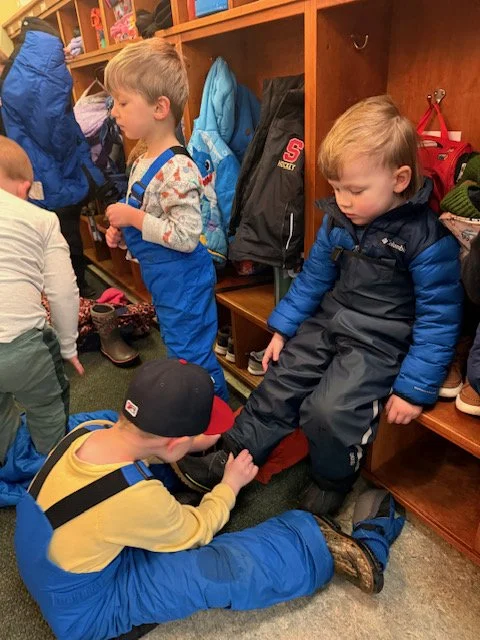
If a child helps a friend up after a fall, offers to zip a coat, opens a tricky snack, or even holds a friend’s hand who is having a rough morning, we point it out, making sure to comment on the action both to the helper and the one who was helped. “That was so kind of you.” “Isn’t it nice to have a friend help you?” “I’m so proud of you for being such kind friends!” When we make the impact of their actions visible, kindness becomes something the children notice, value, and eventually do without coaching. Before long we see children eager to help zip coats and put on shoes, or offering compliments, and saying please and thank you, all unprompted.
These moments may seem small, but for young children, they are the foundation of friendship. I’ll never forget one moment in particular. A child noticed a sad classmate. He didn’t know why, only that his friend was sad. He walked over and said, “Would you like to sit by me at snack? Will that make you feel better?” And it did! In the simplest way he knew how, he offered connection. The other child felt seen, important, and cared for. That is where kindness begins.
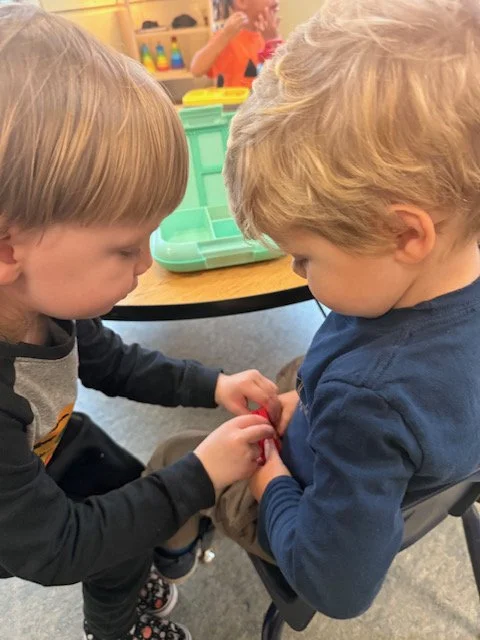
Encouraging our class to treat each other with kindness, to offer a helping hand, to notice when someone is out of sorts, to forgive, and to acknowledge mistakes or regrets teaches them what kindness looks like and feels like. They are some of the most worthwhile lessons we learn in preschool. By setting the tone early on in their young lives, our deliberate practices cultivate a set of character traits that will serve not only our students as individuals throughout their entire lives, but also our community and beyond. And that brings me hope and makes me proud of the work we do at All Seasons.